Boilers
Install Underground Insulated PEX
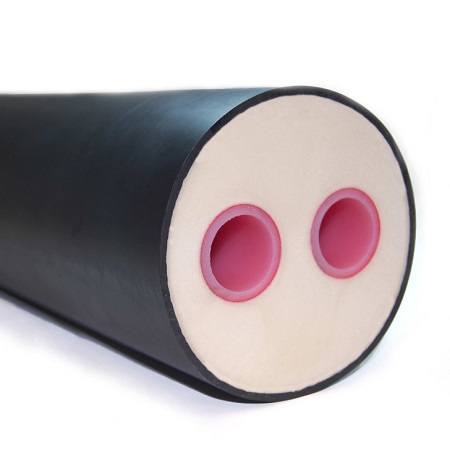
Installing underground PEX (cross-linked polyethylene) like Thermopex, Rhinoflex, Rehau, or other high-quality underground PEX with a closed-cell foam insulation jacket is an excellent choice for its flexibility, durability, and insulation value. Here's how the installation process breaks down.
Step 1: Plan the Route
Identify the boiler location and the building entry point. Locate any obstructions — tree roots, foundations, wells, septic, and underground utilities — by calling your local Diggers Hotline and other utility marking services before you dig. Stay outside the drip edge of trees to avoid tree kill. Since your outdoor boiler will need power, plan for direct-bury 12-2 wire in the same trench, and estimate total PEX length as the route distance plus about 10' extra for depth transitions and working room at both ends.
Step 2: Plan the Building Entrance
For a basement or crawlspace, you have two general options: core-drilling a 5"–6" hole through the foundation, or entering through the rim joist (the only option for buildings without a basement). Either way, your underground wire feed typically shares the same entry hole as the PEX.
Step 3: Excavate the Trench
Dig a trench (backhoe, excavator, trencher, or shovel) wide enough for the insulated tubing — 6" is typically sufficient, or lay pipe and wire side-by-side with at least 6" of separation in a wider trench. Depth depends on local codes and soil conditions, but a common rule of thumb is at least the direct-bury depth required for electrical wire (often 24"). Where PEX comes up out of the ground, plan for about 4' of depth to allow enough bend radius to go perpendicular. Areas with heavy machinery or driveways may require 4' or more — check the manufacturer's spec for high-traffic areas.
Step 4: Install the PEX and Wire
Cap or tape the PEX ends to keep debris out before installing. Lay the electrical wire first if you're running power to the boiler, then sprinkle 4" of loose fill with no large or sharp rocks. Lay the PEX in the trench, leaving at least 2' protruding above the boiler foundation. If entering through a basement wall, push the PEX through with about 1' left on the inside, then seal the gap around the foundation penetration with hydronic cement and a waterproof coating.
Step 5: Connect the Fittings
Trim back the outer PEX insulation jacket and clean the tubing to the correct length. For PEX-A or PEX-B, connect fittings with a crimping tool or clamp ring tool; PEX-A can also use an expansion tool and expansion fittings. Make sure every fitting is fully seated.
Step 6: Pressure Test
Before backfilling, pressure test the system with a gauge to confirm it holds within the recommended range, and repair any leaks before covering the trench.
Step 7: Backfill
Use sand or clean fill to protect the tubing from sharp rocks or debris — keep anything larger than a baseball away from the PEX — then compact the soil around the tubing to prevent settling and leave a smooth, level surface.